
Fields in Door County Property Tax Records
These records pull from several offices at once. Municipal assessors set the values. Local treasurers handle the bills. The county treasurer coordinates collection while hosting a parcel-payment lookup. LandNav and the Web Map tie parcel details to the owner of record. That link also covers the mailing address, PIN, situs, and tax data. The tax bill and the assessment record answer related questions. They are separate records, though, and they do not always update at the same time.
| Field | What It Shows | Where |
|---|---|---|
| Assessed value | Municipal value used in property taxation | Municipal assessor / LandNav |
| Parcel identity | PIN, situs, mailing address, municipality | LandNav and Web Map |
| Tax bill | Amount billed and installment schedule | Local treasurer / county payment portal |
| Payment status | Paid, due, or delinquent status when displayed | Treasurer's parcel payment search |
| Tax districts | Local taxing jurisdictions tied to the parcel | Assessment and tax record |
Wisconsin law requires real property to be assessed at market value. An assessment is still not an appraisal or a promised sale price. DOR equalized value works differently. It measures an entire municipality. Assessed totals can then be compared against a state estimate. A tax bill also reflects the levy and the parcel's share of the tax base. The Door County property value page sorts out what each figure means. A value is never mistaken for a sale quote.
Nineteen Door County Tax Districts
Door County splits into nineteen municipalities, so jurisdiction comes before anything else. No single county assessor exists. Each city, village, and town assesses its own parcels. Its own treasurer mails bills and receives payment. The county treasurer coordinates collection across all of them. Mailing addresses can mislead here. A Sturgeon Bay address might sit in the City of Sturgeon Bay or the Town of Sturgeon Bay. Each hires a different appraisal contractor. Always confirm the parcel's tax municipality before contacting an assessor or a Board of Review. The county's assessed-values page lists municipal contacts. It routes disagreements to the right local assessor and review board. Associated Appraisal Consultants serves the City of Sturgeon Bay. Sleepy Creek Appraisals serves the Town. Their phone numbers differ. A postal city name alone will not identify the correct office. LandNav's municipality field and the Web Map Municipal Civil District layer give a county-side cross-check. Door County's assessed-values page lists assessors and Board of Review contacts for every local district.
Door County Tax Bills and Due Dates
Local treasurers mail Door County tax bills in early or mid-December. Pay in full by January 31. Or split the bill into installments due January 31 and July 31. Miss an installment and the whole bill turns delinquent. The county lists 1.5 percent monthly interest and penalty starting February 1. Those deadlines make the parcel payment page handy for checking a balance. Questions about a bill or a posted payment still go to the local treasurer. The county payment page discloses its processing charges. Credit and debit run 2.39 percent. VISA debit costs $3.95. An electronic check costs $1.50. Electronic processing requires at least $5 in tax. Rates can change, so confirm them before paying. The county page also links a 2026 DOR guide. Read Door County tax records by tax year and by municipality. Payment data and assessment values describe different periods. Before paying, match the parcel PIN, municipality, bill year, owner or mailing name, and amount due. A Sturgeon Bay mailing label cannot tell you who issued the bill. It may be the City or the Town. Save an electronic receipt or other confirmation showing the tax year and parcel number. The local treasurer handles posting questions for its district. The county coordinates collection, but municipal treasurers receive the payments and explain district balances. The county's payment information page gives due dates and payment methods. The official bill and payment instructions appear there.
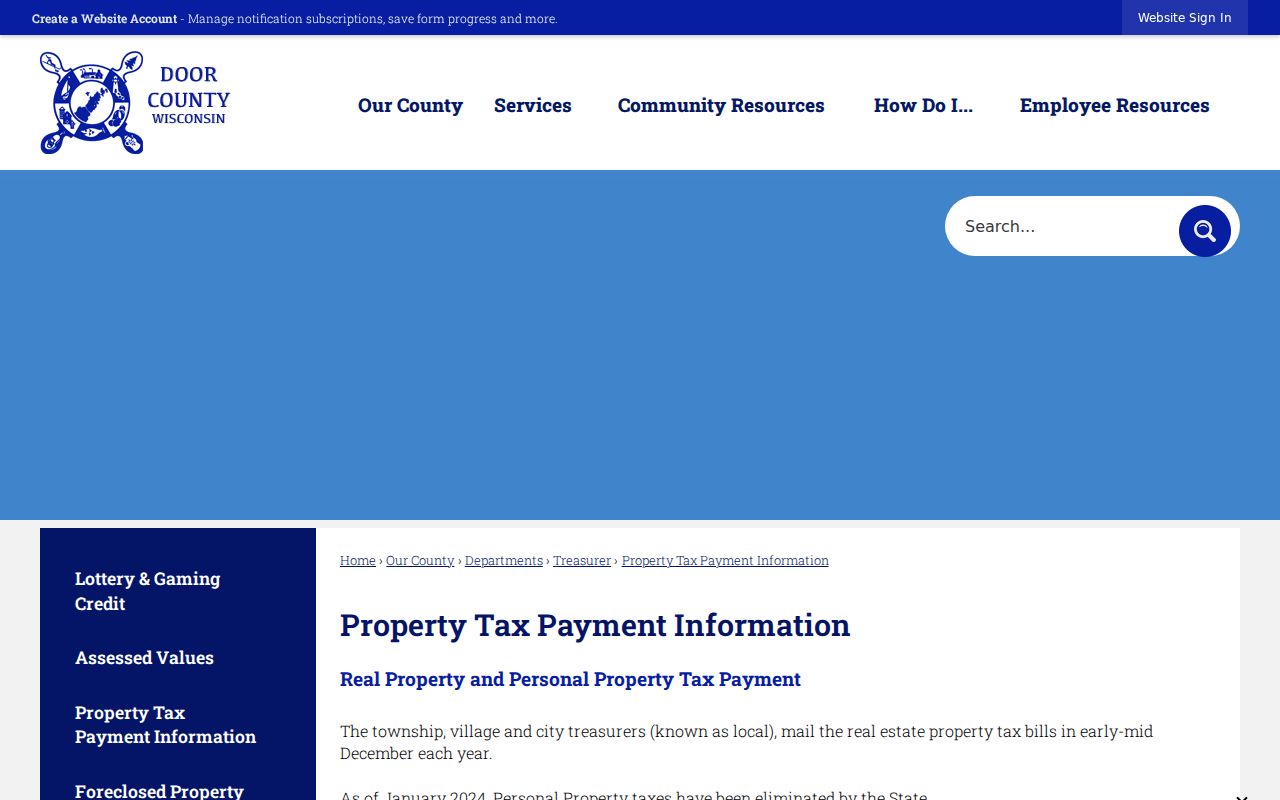
Use the current payment page for live instructions, and confirm any posted payment with the treasurer.
Finding a Door County Tax Bill
Start with the parcel number whenever you have it. Without one, search the address in LandNav or the county Web Map first. Then follow the county tax-payment link. A PIN clears up confusion fast. That matters when one street address covers several units. It also matters when a postal locality crosses a city line. Before checking the amount due, compare the owner, mailing address, municipality, and parcel. Door County's system ties payment data to parcel records. But the town or city treasurer is the office that actually receives local payments.
- Locate the parcel in LandNav using its PIN, owner, address, or municipality.
- Copy the PIN and municipality, then open the county parcel-payment search.
- Check the bill year, amount due, payment status, and installment terms.
- Contact the local treasurer about receipt or balance questions; contact the assessor about value.
- Assessed value
- The municipality's value for property-tax administration.
- Equalized value
- A state measure used to compare municipal assessed totals.
- Levy
- The amount a local taxing body raises, shared across its tax base.
- Delinquency
- A bill status after required payment is late.
Door County Assessment and Equalized Value
Wisconsin law asks that real property be assessed at market value. That standard appears in Wis. Stat. §70.32. In Door County, that job belongs to each municipality. The local assessor values the parcel. The Department of Revenue then compares each municipality's assessed total against its own equalized value. The result is an aggregate ratio. That ratio describes a whole municipality. It does not promise any single sale will match an assessment. DOR also publishes statements of assessment, equalized values, and assessment-to-sale reports. These help anyone who wants the wider context.
An assessment that rises 10 percent does not automatically raise a tax bill by 10 percent. The levy matters. So does the parcel's share of the total tax base. A property owner comparing figures should confirm the municipality and tax year first. Then ask the local assessor about the parcel record. Any challenge runs through the assessor's notice and the Board of Review. Door County publishes no single countywide appeal deadline, so the notice itself controls.
Assessed-value contacts in Door County are listed by municipality rather than through one countywide assessor. The right assessor can explain the assessment year, the property class, and the notice. The notice is attached to an individual record. A treasurer answers payment questions. A treasurer does not judge whether a value is correct. Keeping those roles separate makes comparisons easier. It becomes simpler to compare a tax bill with an assessed or equalized value.
Door County Board of Review Route
In Door County, an assessment disagreement goes to the municipal assessor. Then it goes to the Board of Review. Start with the assessed-values roster. Confirm the taxing municipality. Read the hearing or objection notice for the current procedure and filing date. The county publishes no countywide deadline, no single exemption list, and no standard evidence form. A date copied from another Wisconsin city could be wrong here.
Good evidence speaks to the property and the assessment at issue. A recorded sale can help as context. But it is not automatically the assessor's own conclusion about market value. Keep the parcel number, the assessment year, and the notice together. Ask the assessor which records or comparable sales the local board accepts. Bill balances belong with the treasurer. Value questions belong with the assessor. The Door County value explanation covers what the assessment number itself means.
Check the local notice. Door County uses municipal assessors and review boards. Confirm the current meeting date, filing steps, and evidence rules with the correct district before relying on any deadline.
Door County Delinquent Tax Property
Door County treats three years of unpaid property taxes as the threshold for foreclosure. Under Door County Code §§3.16 and 3.17, the county follows in-rem tax-lien enforcement under Wis. Stat. §75.521, and land acquired through a county tax deed can be sold under §§75.35, 75.36, and 75.69. Keep the steps separate. A delinquent tax bill, a tax lien, a foreclosure case, and a county sale are four different things, so check the treasurer's payment data and the court docket before reading a sale notice as proof of current ownership.
The 2025 tax-delinquent sale booklet set its own rules. Each bid needed a parcel label, came sealed, and required a 10 percent deposit with the balance due within 30 days. The booklet also made no promises about zoning, access, wetlands, floodplain, drainage, or other site conditions. Those terms belong to that one sale rather than to property-tax payment generally, so review the current booklet and ask the Treasurer before bidding on anything live.
Door County's sale notices reflect a separate foreclosure track. A sheriff notice is a county-issued example of that process, not a routine tax bill.
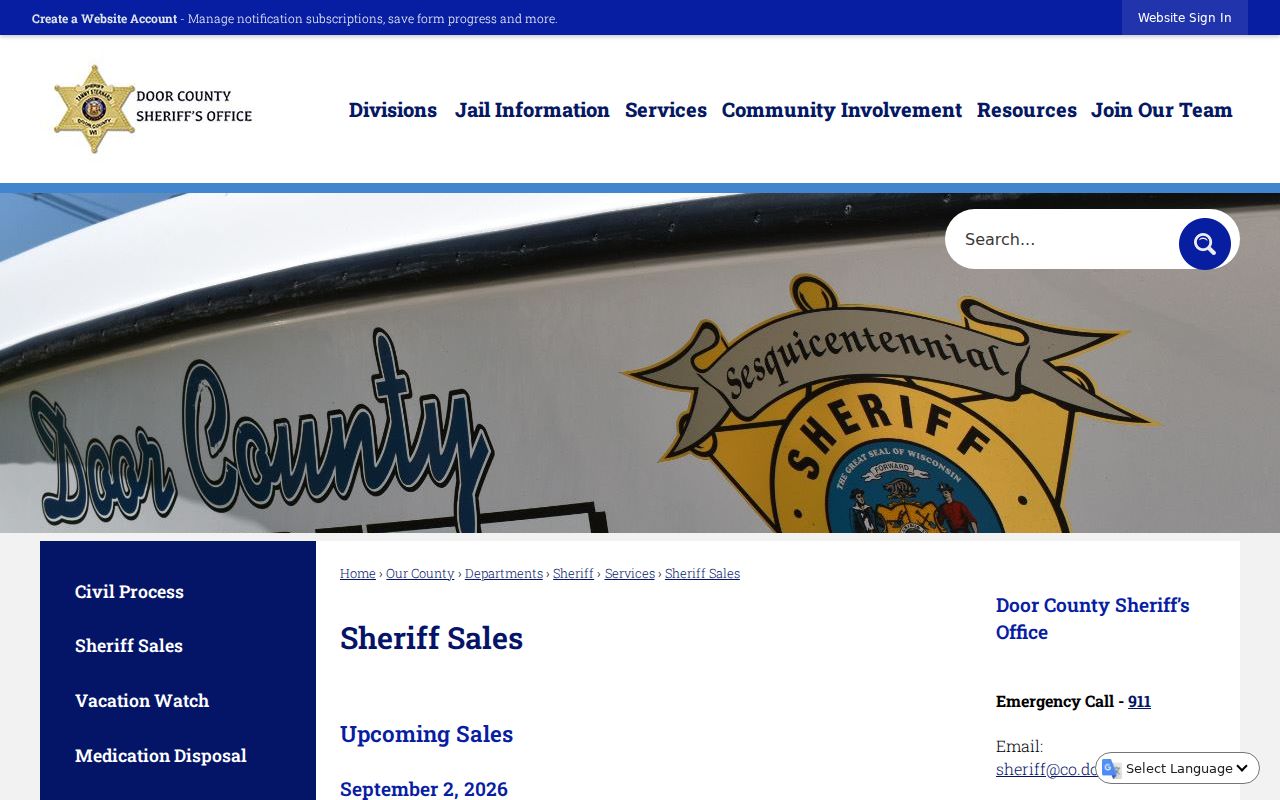
Verify any sale notice with the sheriff and circuit court.
Door County Assessment Review
Assessment review in Door County begins with the municipal assessor who placed the value. From there it moves to the Board of Review in that same tax district. The county publishes the assessor roster. It also points owners toward the local board. A current notice sets the meeting and filing requirements. There is no countywide calendar for this. Keep payment questions apart from a value objection. A bill stays due on its own schedule while an assessment is under review.
Local review date. No single countywide assessment-appeal deadline was verified. Contact the municipal assessor and Board of Review listed for the parcel to confirm the notice, filing date, and current evidence rules.