
Door County Owner-of-Record Fields
Start with the Door County assessment record when you need the owner shown today. LandNav and the Web Map pull the owner name together with the tax mailing address, situs, PIN, municipality, and both assessment and tax detail. It all sits in one parcel view. The exact parcel card layout varies, though. A field may be missing or carry a different label on your result. Treat whatever owner name appears as the tax-system entry. When vesting or timing matters, pull the recorded deed and compare.
| Owner of record | Name held in the assessment/tax entry |
|---|---|
| Mailing address | Destination for tax notices |
| Situs address | Location address assigned to the parcel |
| Municipality | City, town, or village taxing district |
| PIN and legal description | Cross-reference to map and recorded land |
| Latest deed reference | Confirm through the Register of Deeds image |
The mailing line only tells you where tax bills and notices go. It might name an agent, a lender, a trust, or an out-of-county address instead. Neither the mailing line nor the situs proves who actually lives there. For that, a deed image shows the grantee and vesting language. That language explains why the tax entry carries an individual, trust, estate, or LLC name.
Door County's Catalis public portal opens with a Guest Sign In screen. It then links onward to tax parcel data. That entry page is the gateway rather than an individual parcel card.
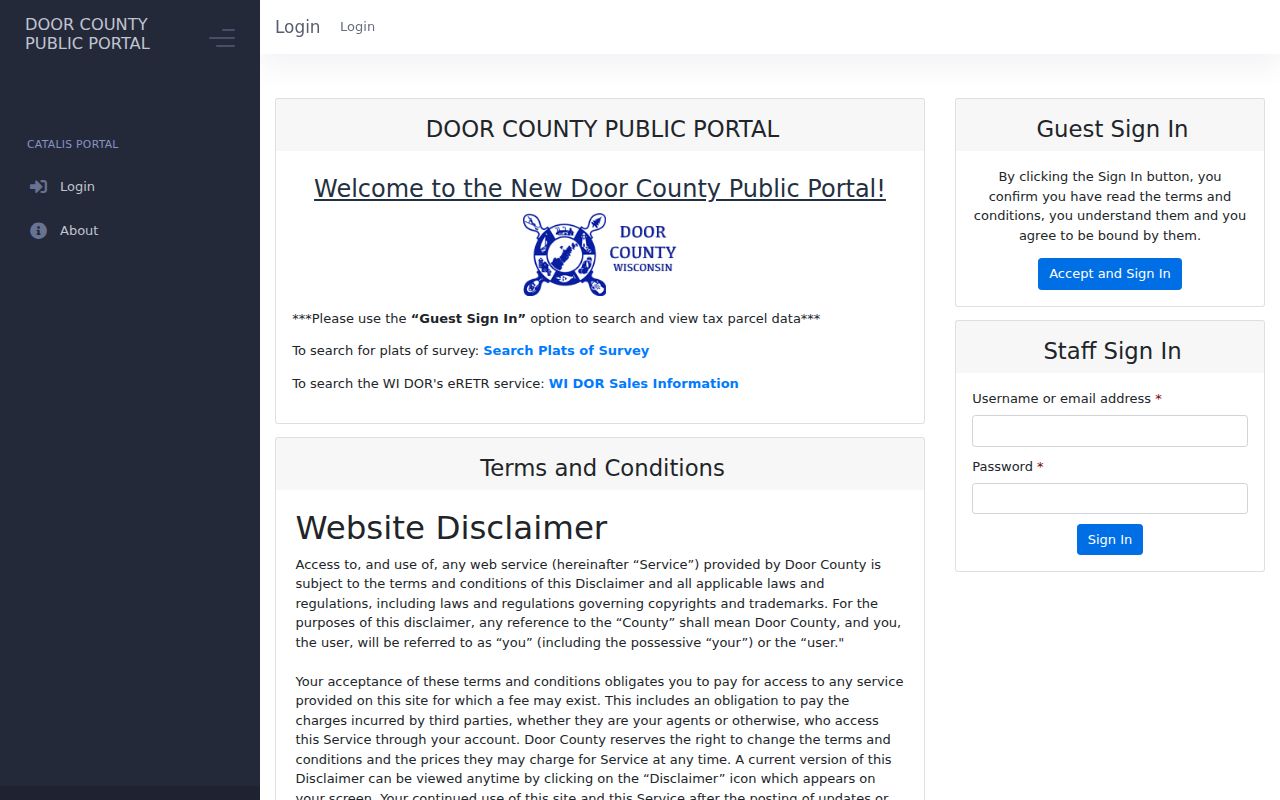
Use the parcel details you reach through the portal as a starting record. Then confirm any recent transfer in the deed system.
Door County Owner Roll Update Timing
An owner entry is only as fresh as its source's last update. Door County's Land Information Plan describes assessment data joined to parcel geometry nightly. Even so, a newly recorded deed, the assessor's row, and the tax detail can each carry different update dates. The map popup can differ as well. No fixed number of days separates a closing from a refreshed owner field.
After a recent sale, set the deed's recording date beside the parcel's owner field. Compare it with the mailing field too. The deed may be recorded, but the roll may still show the seller. If so, ask the municipal assessor about its update cycle. Use the latest instrument to verify the grantee. Just don't stretch one deed result into a full chain-of-title conclusion. To build an owner search from scratch, see the Door County ownership lookup page.
Confirm the Door County Current Owner
Confirming the current Door County owner is a two-source exercise. Compare the municipal roll against the most recent recorded instrument for the same parcel. Begin with the PIN and legal description. That way a similarly named person or a nearby lot doesn't get mistaken for the subject property. Tapestry's online grantor/grantee index reaches back to 1981. But it is not fully verified. For earlier questions, a counter terminal or tract index may be the better route. The Register of Deeds holds both.
- Find the parcel by address or PIN and note municipality and legal description.
- Read the owner and mailing fields in LandNav or the Web Map.
- Search the Register of Deeds for the newest relevant conveyance and compare its grantee and land description.
- For an LLC or corporation, verify the exact name in Wisconsin DFI records.
- Owner of record
- The name carried in the assessment or tax system.
- Vesting
- The form in which an instrument conveys the interest.
- Registered agent
- A business filing contact, not necessarily the beneficial owner.
- Recording lag
- The time between filing a deed and a related tax or map field changing.
Which Door County Assessor Handles the Parcel?
Door County spreads assessment work across its nineteen municipalities rather than using one countywide assessor. The parcel's tax district decides which office handles it. The county roster lists Associated Appraisal Consultants for the City of Sturgeon Bay. It also lists Sleepy Creek Appraisals for the Town of Sturgeon Bay. That split matters. A Sturgeon Bay postal address can sit outside city limits. The city and town run separate governments and review boards.
Before calling, check the Municipality field in LandNav. Check it against the Web Map's Municipal Civil District layer. The county's assessed-values page points to each municipal assessor and its Board of Review route. An owner search may also raise a value question. In that case, take the parcel entry to the assessor. Recorded instruments belong to the Register of Deeds, and payment status to the treasurer.
Door County Trusts, LLCs, and Estates
The owner name on a parcel is often an entity, not a person. LandNav's owner search accepts last and first name. The Web Map takes a partial last name. When a deed names a trust or business, search that exact wording, then compare the parcel and mailing details. The Wisconsin DFI Corporate Records Search can clarify an LLC's or corporation's legal name, registered agent, status, principal office, and filing history.
A registered agent is not a beneficial owner. An estate may appear as "Estate of" or under a personal representative, while a trust gets indexed by trustee or trust name. Never assume who controls an entity from a mailing address or agent listing. Read the deed's vesting language, and get legal advice if the ownership form affects a transaction or estate matter.
Door County Current and Historical Entries
LandNav's Include control covers both current and historical properties. That matters more than it sounds. A parcel split, merge, or older legal description can change things here. One name can stay attached to several results. Start with the current parcel. Write down its PIN and municipality. Then look at older entries only if you need a dated transfer or tax history. An old result does not tell you who holds the parcel now.
Door County gives you two paths into the same data. The Web Map and LandNav each run parcel searches differently. Yet both tie parcel identifiers to assessment information. The county joins its data nightly. That can leave the owner field and the map label briefly out of step. Keep the date and source with every result. That habit prevents mixing a historical entry with a current one.
Door County Owner Name Versus Title
The assessment roll answers a narrow question. Who does the county recognize as the owner for tax purposes? A recorded deed is different. It supplies the filed conveyance and its vesting language. Even the newest deed is not a full title commitment. A parcel can sit in joint names, a trust, an LLC, or an estate. An entity's registered agent is not always its beneficial owner.
Surprises in a name call for a closer look. Compare the exact grantee name and the legal description in the instrument itself. Wisconsin DFI's Corporate Records Search can pull a business filing. The municipal assessor can speak to the tax record. Never infer personal control or occupancy from a name alone. Confirming the current owner is a parcel-record task. Tracing prior owners is a separate historical chain.
Door County Owner Mailing Record
A tax mailing address is a notice destination. It does not prove the owner lives there. The addressee might be a trust, a lender, an agent, or someone far outside Door County. Use it only for a legitimate property matter. The owner field will not identify an occupant for you. Wisconsin Safe at Home and other privacy provisions can also affect how an address displays.
For a current owner check, note the tax year or last-updated date. Compare the parcel number against the most recent deed. County mapping joins assessment data nightly. So the map geometry, the tax owner roll, and the document index can each refresh on its own schedule. A recent sale may not have reached the tax screen yet. In that case, review the instrument filed with the Register of Deeds. Even then, a name on the instrument means something. Read the deed's full vesting language before drawing conclusions.
Official questions go to two offices. Ask the municipal assessor listed for the tax district. Or ask the Register of Deeds for a recorded instrument. Wisconsin Public Records Law, Wis. Stat. §§19.31–19.39, presumes records open, subject to exemptions and balancing tests. That presumption does not expose every personal identifier. Keep any record request narrow. Name one property and a date range rather than seeking unrelated personal details.
Lawful use. A Door County owner record supports property due diligence and tax questions. Do not use a name or address to stalk, harass, threaten, or harm anyone.